


Quick Summary
This is the final phase of solving DLPs. Our goal is to convert a big integer into a product of small prime numbers over our factor base.
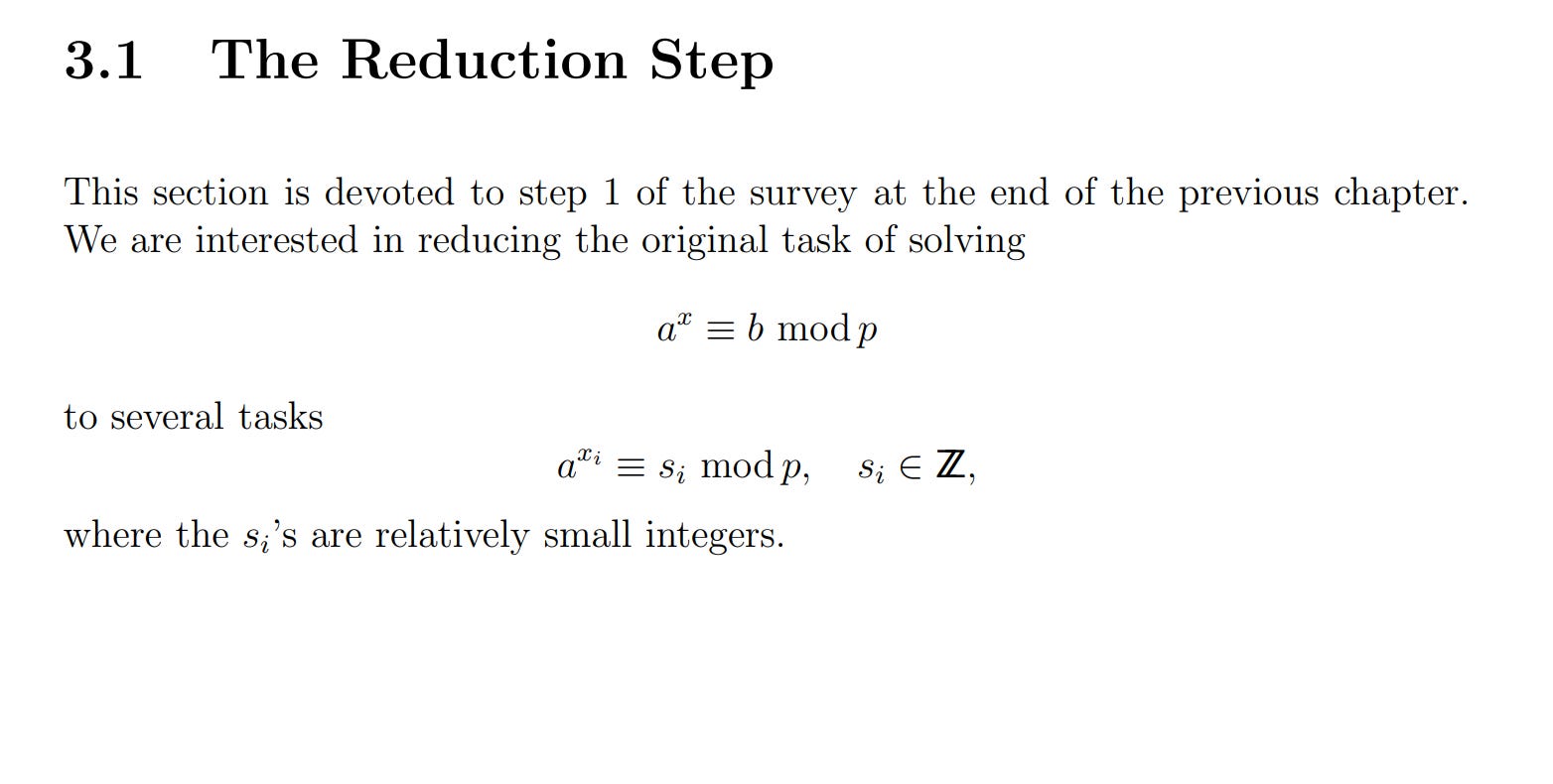
We assume familiarity with index calculus techniques. This is part of our series on Practical Index Calculus for Computer Programmers.
Part 1: Discrete Logarithms and the Index Calculus Solution.
Part 2: Solving Pell Equations with Index Calculus and Algebraic Numbers.
Part 3: Solving Index Calculus Equations over Integers and Finite Fields.
Part 4.1 : Pollard Kangaroo when Index Calculus Fails.
Part 4.2 : Pohlig-Hellman Attack.
Part 5 : Smart Attack on Anomalous Curves.
Part 6: Hacking Dormant Bitcoin Wallets in C.
Part 7.1: Gaussian Integers Introduction.
Part 7.2: Linear Algebra Phase.
Part 7.3 (we are here): Reduction and Descent by Sieving.
As usual, the code is available on GitHub and Colab.
1.0 Introduction
We shall use our database of primes (and their virtual logarithms) from Part 7.2 to solve individual DLPs. We do this finding a factorization of our target into primes over our factorbase. This phase of solving DLP’s is either called the Reduction Phase or the Descent Phase in different books.
Our primary source is (Weber, 1997)1.
1.1 Descent/Reduction Phase Algorithm
We summarize below the steps of the reduction phase.
Find rational reconstruction of target modulo prime.
Find prime factorization of numerator and denominator.
Find appropriate sieving polynomials for each large prime factor (t) modulo prime.
Find k, an exponent of 2 that places t in the range √p/2 ≤ t ≤ √p or equivalently:
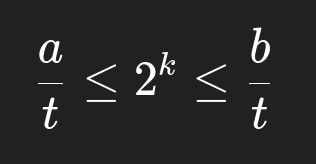
Finding k Find the new value of t by multiplying by 2^k.
Find t’ such that:
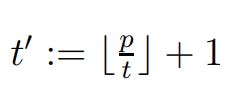
Finding t prime from the modified t Construct sieving polynomials of the form:


Listen to this episode with a 7-day free trial
Subscribe to LeetArxiv to listen to this post and get 7 days of free access to the full post archives.


